The Queens of Welfare Island — Episode Two: Let’s All Be Fairies
 Cartoon published in a 1932 issue of the German satirical magazine "Lustige
Blätter."
Episode Notes
In 1925 Gene Mosely was sent to the men’s penitentiary Fag Ward on a “masquerade” charge. Despite the risks of cross-dressing, drag balls flourished and female impersonators took NYC’s nightlife by storm, while the mainstream visibility of “fairies” became a cultural phenomenon: the Pansy Craze.
Episode first published October 26, 2026.
———
Learn more about some of the topics and people discussed in the episode by exploring the links below.
The character of Gene in The Gorgeous Nothings:
- General information about the musical (Life Jacket Theatre Company).
- Brief interview with Allan K. Washington, the actor who plays Gene.
- 1926 recording of Gene’s signature song, “How Could Red Riding Hood?” by The Yacht Club Boys (cdbpdx/YouTube).
George Chauncey:
- Columbia University profile page.
- Gay New York: Gender, Urban Culture, and the Making of the Gay Male World, 1890-1940 (Basic Books, 1994), an invaluable resource for the “Queens of Welfare Island” series, including on the subjects of the fraught legal landscape homosexuals and gender-nonconforming people faced in the 1920s and ’30s and the Pansy Craze (a term Chauncey coined).
- Video interview about queer life in 1920s and ’30s New York City (American Masters Digital Archive/WNET; conducted for a documentary about gay icon Mae West).
The Ziegfeld Follies:
- Ziegfeld: The Man Who Invented Show Business by Ethan Mordden (Macmillan, 2008).
- “Florenz Ziegfeld: The Incarnation of Broadway” by Jaap Harskamp (New York Almanack, 2022), an overview of Florenz Ziegfeld’s life and contributions to American musical theater.
- Glorifying the American Girl, the 1929 film featuring a partial recreation of the Ziegfeld Follies; the mermaid scene discussed in the episode starts 64 minutes in (arkiver2/Internet Archive).
- “Kahn and Ziegfeld: Glorifying the American Girl” by Andrea Nolan, an analysis of the Ziegfeld Follies portion of the film.
The Pansy Craze:
- “How Gay Culture Blossomed During the Roaring Twenties” by Sarah Pruitt (History.com) and “Pansy Craze: The Wild 1930s Drag Parties That Kickstarted Gay Nightlife” by Darryl W Bullock (Guardian, 2017), concise overviews of the rise and fall of the Pansy Craze.
- Clippings, background information, and links to music and resources about the Pansy Craze era and its most notable entertainers courtesy of Queer Music Heritage.
- “Let’s All Be Fairies” by Durium Dance Band, one of the defining songs of the era, released in 1933 (PrincessBunhead/YouTube); also included in the episode is a 1926 recording of Irving Kaufman’s “Masculine Women! Feminine Men!” (CurzonRoad/YouTube).
- The speakeasy scene in the 1932 pre-Code film Call Her Savage, a quintessential example of the visibility of the pansy in popular culture; primer on the Hays Code (1934-1968), the self-censorship guidelines adopted by the motion picture industry that effectively banned such positive or neutral queer representation in Hollywood film.
Bert Savoy & Jay Brennan:
- “You musssssst come over,” a brief appraisal by Benjamin Dreyer.
- Recording of the comedy routine “You Must Come Over” (Old Grooves/YouTube).
- Extensive collection of clippings, photos, ephemera, and links to recordings (Queer Music Heritage).
- Savoy’s 1923 New York Times obituary.
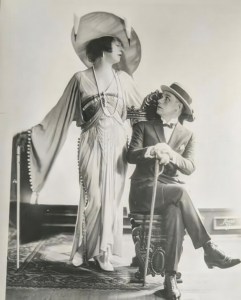
Gene Malin (stage name Jean Malin):
- Brief biography (Legacy Project).
- “Jean Malin: Queen of the Pansies,” a short PBS American Masters documentary.
- 1932 recording of “I’d Rather Be Spanish Than Mannish” (cpaulphl/YouTube).
- Extensive collection of clippings, photos, ephemera, and links to recordings (Queer Music Heritage).
———
Episode Transcript
Eric Marcus: The next line should be, “And he looked fabulous.”
Allan K. Washington (Gene, The Gorgeous Nothings): It should be, it should absolutely be, “And he looked…”
EM & AW: “… fabulous.”
———
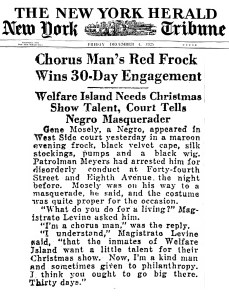
Eric Marcus Narration: The actor Allan K. Washington and I are sitting across from each other, and he’s reading aloud an article published in the New York Herald on December 4, 1925. The headline reads, “ Chorus Man’s Red Frock Wins 30-Day Engagement.” It’s about an arrest in Midtown Manhattan.
———
AW: [Reading the New York Herald Excerpt:]
Gene Mosely, a Negro, appeared in West Side court yesterday in a maroon evening frock, black velvet cape, silk stockings, pumps, and a black wig. Patrolman Meyers had arrested him for disorderly conduct at 44th Street and Eighth Avenue.
My gosh, that’s right here.
———
EM Narration: Coincidentally, we’re in a recording studio just a few steps away from Times Square, the exact same block where Gene Mosely was arrested more than a hundred years ago.
———
AW: [Reading the New York Herald Excerpt:]
Moseley was on his way to a masquerade, he said, and the costume was quite proper for the occasion.
“What do you do for a living?” Magistrate Levine asked him.
“I’m a chorus man,” was the reply.
“I understand,” Magistrate Levine said, “that the inmates of Welfare Island want a little talent for their Christmas show. Now, I’m a kind man and sometimes given to philanthropy. I think you ought to go big there. Thirty days.”
What? Oh, my goodness. So the magistrate is sort of the casting director for the “Fag Follies.” Wow.
———
EM Narration: The “Fag Follies” was the yearly Christmas pageant staged inside the men’s penitentiary on Welfare Island in the 1920s and ’30s. In drag.
———
AW: They’re like, oh yeah, you look like a performer, you look fabulous. They need some folks for their holiday concert at the prison. I’m gonna, I’m gonna send you over there for 30 days. That’s wild.
———
EM Narration: I’m Eric Marcus, and this is Making Gay History: The Queens of Welfare Island.
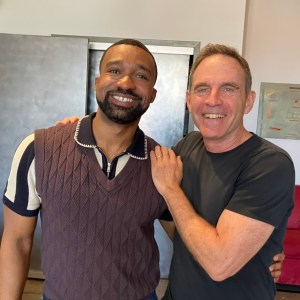
That drag Christmas show—the “Fag Follies”—is being recreated on stage in New York City in the form of a new musical, The Gorgeous Nothings, and Allan K. Washington plays the character of Gene. Gorgeous Nothings Gene is based in part on the Gene we’re reading about in this old copy of the New York Herald: Gene Mosely.
Of all the real stories that inspired The Gorgeous Nothings, Gene’s is the one drawn from the fewest scraps. Gene Moseley didn’t leave us much of a paper trail. We don’t even know if that was his real name or just a pseudonym he gave the police. But those scraps aren’t the end of Gene’s story, because we can look back in time to the world in which he lived and how he fit into it.
In this episode, we’re gonna follow the breadcrumbs left in the press clippings, through the woods, to fairyland; we’ll go to the follies, both Fag and Ziegfeld; and rediscover an early-20th-century queer identity, nearly forgotten, which was both celebrated and criminalized, sometimes all at once.
This is episode two: “Let’s All Be Fairies.”
———
The Yacht Club Boys: [Singing “How Could Red Riding Hood?”:]
… modern child is runnin’ wild
He wants to know too much
He’s never understood
About Red Riding HoodSay, how could little Red Riding Hood
Have been so very good
And still keep the wolf from the door?Father and mother…
———
EM Narration: We only know Gene Moseley through a few short newspaper clippings, yet Gene leaps off the page, as vivid as any New York City character.
———
EM: I just love the description. It’s just—whoa.
AW: Yeah.
EM: Yeah, that took time to get, uh, to get, to get that fabulous.
AW: It took a lot of time. The pumps, the stockings, the cape…
EM: Yeah.
AW: Yeah. And the black wig.
EM: And arrested for that?
AW: And arrested for that.
———
The Yacht Club Boys: [Singing “How Could Red Riding Hood?”:]
Why was she dressed up in her bright flaming red
Unless she expected to knock someone dead?
Why did she ramble…
———
AW: Just the image of, like, being in a cape, and this velvet cape. I mean, I get stuck on the cape because Gene talks about wearing a, a flaming red evening cape in the show.
———
Multiple GN Characters: This morning we catch one of the homosexuals wearing one flaming red evening cape, one pair…
———
EM Narration: That’s Allan reading from the Gorgeous Nothings script. He’s been living with “his” Gene since joining the production in 2022.
———
Doctor #1, GN (Ken Barnett): The inmate immediately confessed.
Gene, GN (AW): Of course I stole them dirty rags. But, baby, it was a drag emergency.
———
EM Narration: The playwright behind The Gorgeous Nothings, Travis Lee Russ, conjured this Gene from scraps in the archive, while Allan K. Washington brought his own life experience and flair to breathe life into this sketch of Gene.
———
Travis Russ: Page 71.
AW: Yes.
TR: I think we could leave it there.
———
EM Narration: Allan’s Gene is not a historically factual Gene Mosely, but a version of Gene who reaches back through time as a bridge between the 1920s and today.
———
Doctor #2, GN (John Cariani): The inmate has been cross-dressing since—
Gene, GN (AW): Age 15, baby. The day my daddy kicked me out the house and, baby, this fine Black ass hopped a Greyhound from Baltimore, and I ain’t never looked back.
———
AW: Gene is a firecracker. Gene is a Black queer person. I think in modern language, Gene would be a nonbinary, gender-nonconforming person, if not a trans person, who really is unapologetically themself.
———
EM Narration: While Allan refers to the fictional character in The Gorgeous Nothings with they/them pronouns, the historical record of the real Gene uses masculine pronouns, and without Gene Moseley’s word on the matter, that’s what we’re using.
———
Gladys Bentley, GN (J. Harrison Ghee): What you want, kid? I’m workin’ here.
Gene, GN (AW): S-s-sorry to bother you, Ma’am, I-I-I’m just looking for a job.
———
EM Narration: In The Gorgeous Nothings, fictional Gene is incarcerated on the Fag Ward for wearing women’s clothes—specifically, for performing in drag at a Harlem club called Gladys’s Clam House under the direction of Harlem’s most famous male impersonator, Gladys Bentley.
———
Gene, GN (AW): But I need a job
Gladys Bentley, GN (JHG): Ah-ah.
Gene, GN (AW): I just need to get my foot in the door.
Gladys Bentley, GN (JHG): And I said no, little boy. Go home, this ain’t no place for you.
Gene, GN (AW): I don’t care what I gotta do.
———
EM Narration: That’s Allan opposite J. Harrison Ghee reading as Bentley. In the play, finding their way in New York City and struggling to survive, Gene stumbles into the world of drag.
———
Gene, GN (AW): Something changes. Like, everything clicks, like it’s the Fourth of July and Halloween and Christmas and my birthday and New Year’s all rolled up into one.
———
EM Narration: Fictional Gene is naturally the star of the play within a play: the “Fag Follies” performance at the heart of The Gorgeous Nothings.
———
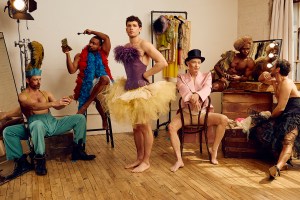
Gladys Bentley, GN (JHG): And now, for the first time here at Gladys’s Clam House, we have a special treat for y’all white motherfuckers. We like to call her Little Red Riding Hood.
———
EM Narration: Gene’s big number is “How Could Red Riding Hood?”—a salacious, over-the-top song that melds Gene’s memory of performing in Harlem with the far less glamorous world of the “Fag Follies” and the men’s penitentiary.
———
Gene, GN (AW): [Singing “How Could Red Riding Hood?”:]
How could Red Riding Hood
Have been so very good
And still keep the wolf from the door?
———
EM Narration: Gene struts around the makeshift prison stage, putting his whole body into the song’s already suggestive lyrics, turning a familiar fairytale into a bawdy, bold burlesque number about a good girl gone very, very bad.
———
Gene, GN (AW): [Singing “How Could Red Riding Hood?”:]
They say she found a big bad wolf in Granny’s bed—gasp!
A big sunbonnet pulled over his head…
———
EM Narration: This song, this rendition, is a collision of fact and fiction. Allan’s Gene, as Red Riding Hood, is echoing the real Gene Mosely, who was arrested in that red frock and cape. Like most of the music in the show, “How Could Red Riding Hood?” is a vintage American Songbook tune the inmates of the real Fag Ward would likely have known.
The song’s refrain—“How could Red Ridin’ Hood / Have been so very good / And still keep the wolf from the door?”— contains a code. “To keep the wolf from the door” is an old idiom meaning to struggle to earn enough to live, to survive in the world.
———
AW: To be able to, like, withstand and endure everything, to still be able to show up and be yourself, that’s Gene. Like, Gene is, has never looked back and never does look back.
———
Gene, GN (AW): [Singing “How Could Red Riding Hood?”:]
And still keep the wolf from the door?
———
EM Narration: One of the things that’s so notable about the real Gene Moseley’s arrest is that it’s one of the few independent references we have to the “Fag Follies.” This wasn’t a glitzy pageant that got tons of press attention. This was a show put on by the most marginalized of the marginalized, in one of the most disgusting prisons in the U.S. It’s a small miracle we know anything about it at all.
And yet, we do know that it meant a lot to the inmates, and we can glean that from the sneering account of a prison doctor, who wrote—
———
Excerpt from Revelations of a Prison Doctor (1934) by Louis Berg (Read by Benjamin Frisch): More than one inmate told me about the “Fag Follies.” This was a sort of entertainment given by the dwellers in the “South” around the Christmas holidays.
———
EM Narration: By the “South” he means the south ward, the Fag Ward, of the Welfare Island prison.
———
Berg Excerpt: All the “talent” combined to put on a show which was staged in their own cell block. The audience was composed of those with sufficient pull to permit them access to the South after the main body of prisoners were locked in.
———
EM Narration: He says of the performances themselves—
———
Berg Excerpt: They were bawdy and intended to stimulate depraved eroticism. … It is doubtful that these exhibitions were of much entertainment value.
———
George Chauncey: I’m George Chauncey. I’m a history professor at Columbia University and the author of Gay New York.

———
EM Narration: George literally wrote the book on gay male history. His landmark book, Gay New York, sparked the inspiration for The Gorgeous Nothings. George’s work is the foundation for so much of what we know about this period of history, the Fag Ward, and the “Fag Follies.”
———
EM: In the show, we see something called the “Fag Follies,” which to me seemed absolutely unbelievable.
GC: The fact that it could exist is both a sign of the effervescence of queer culture outside the prison and is a sign of how institutionalized gender-nonconforming life was in the prison.
EM: So what were the “Fag Follies”?
GC: So the “Fag Follies” were a big performance put on every Christmas for prison authorities, the people who ran the prison, and a select number of prisoners, primarily the crime bosses who ran the prison. It was drawing on Ziegfeld Follies, so it was a form that was very familiar to the so-called fags who put it on.
———
Ziegfeld Follies Emcee: They’re all here tonight to see the first Ziegfeld Follies. The curtain is going up. Listen to those gorgeous girls singing that opening chorus.
Chorus Girls: [Singing:] Here we are…
———
EM Narration: The Ziegfeld Follies were the most famous version of one of the early 20th century’s most popular forms of entertainment: the live, on-stage variety show. A glamourous, bedazzled big sister to the simpler, bawdier vaudeville shows of the era. The follies grew into massive stage productions with huge sets, glamorous costumes, big bands, and orchestras. They’d feature all sorts of acts, with elaborate song-and-dance numbers, comedy sketches, ballads, and more.
These shows were so popular that the acts were often memorialized on records and on film for decades to come.
———
Audio from Glorifying the American Girl (1929): Tonight we’re broadcasting the gala opening of Florenz Ziegfeld’s greatest show, “Glorifying the American Girl.” There he is, there he is: Florenz Ziegfeld.
———
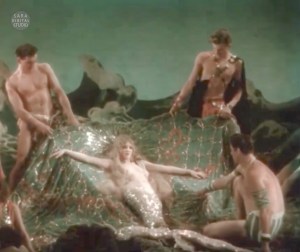
EM Narration: The 1929 film Glorifying the American Girl, produced by Florenz Ziegfeld himself, contains a partial recreation of his Ziegfeld Follies, lavishly filmed in part using Technicolor, which was brand new. Included are a jazz band, a comedy routine, a ballet, and a piano ballad.
———
Glorifying the American Girl Audio: [Rendition of “What Wouldn’t I Do for That Man?”:]
I’ll never leave him alone
I’ll make his troubles my own…
———
EM Narration: One number features girls in giant white feather headdresses doing kick lines, before the curtain opens to reveal a giant tableau of sequined mermaids caught in nets by shirtless hunks. There are also sailors, and for some bizarre reason lost to history, Catholic priests. The performers just hold their poses as the music swells.
———
Glorifying the American Girl Audio: [Chorus sings “Die Loreley” by Friedrich Silcher.]
———
EM Narration: And of course drag—or “female impersonation,” as it was often called at the time—was part and parcel of some of these shows.
———
Jay Brennan: Say, do you know I met a fellow friend of yours this morning?
Bert Savoy: How dare you talk to me, why the idea! I haven’t given you the least bit of encouragement. Why, a girl ain’t safe in the street after 3 or 4 in the morning.
JB: Well, would you like to go for an automobile ride?
BS: No!
JB: No?
BS: I’m just walking home from one.
———
EM Narration: That’s a 1923 recording of “You Must Come Over,” a comedy routine by Bert Savoy and his stage partner, Jay Brennan. Savoy dressed in drag, was enormously popular, and performed in all sorts of variety shows, including the Ziegfeld Follies of 1918.
———
JB: Say, before we go any further, tell me, are you married or single or what is it…?
BS: Or. I’m not married anymore. I’m not married. It takes up so much time. I’m not married. You must come over.

———
EM Narration: Someone like Gene Mosely would almost certainly have been familiar with the Ziegfeld Follies and its cheaper, more accessible imitators. But the fact that inmates put on a follies production in prison––not just with the blessing of the prison authorities, but, if the reports of Gene’s arrest record are to be believed, with casting assistance from the magistrate? Sometimes, the truth is truly stranger than fiction.
———
EM: During this period that we’re talking about, you could be arrested for homosexual behavior as perceived by the authorities.
GC: Yes, for sure. So there were several laws that criminalize various forms of homosexual behavior and presentation.
———
EM Narration: Cross-dressing was illegal under an article of the New York Penal Code, which was originally used to punish the use of disguises to avoid paying taxes. It was later repurposed to punish partygoers. It forbade “the wearing of masks, fancy dresses, or other disguise by persons on their way to or returning from such ball.”
———
GC: “Disorderly conduct” empowered a cop to arrest anyone he thought was disorderly. It could be someone whose gender presentation was nonconforming, it could be someone trying to pick up another man. Not surprisingly, people of color and immigrants and queers were most likely to be arrested under this very expansive rubric.
———
EM Narration: Gene Mosely, who was Black, was arrested on this disorderly conduct charge.
———
GC: A disorderly conduct charge typically resulted in a sentence of 10 to 30 days. That was really disruptive in people’s lives. It threatened to expose them and their queer lives to friends, employers, family members, and so forth.
———
EM Narration: Moseley’s 30-day sentence was handed down on December 3, 1925, landing him in the men’s penitentiary on Welfare Island through the holidays, conveniently in time for that year’s edition of the “Fag Follies.”
———
EM: What really blew my mind was that some of the men were in prison because they had been cross-dressing, and then in the “Fag Follies” they were cross-dressing to perform in front of the whole prison.
GC: And everyone knew that the prisoners had dresses and wigs or wore their hair long and had makeup and so forth. And the prison officers actually went to see this performance.
———
EM Narration: The lax attitude towards the “Fag Follies” was, in part, because of the outsized influence of organized crime in the prison, but more than that, the types of people who were in the prison’s main population were far less squeamish about homosexuals than the administrators and doctors who described the follies and Fag Ward in harsh judgmental terms in the records.
———
GC: In fact, queer life was more open and more accepted, especially in Black and immigrant working-class neighborhoods, in the early 20th century than it would be in the ’40s and ’50s. So working-class people would’ve recognized what was going on in the Fag Annex because many of them moved in a world in which you could see fairies on the streets.
EM: What was a fairy?
GC: Yes, so “fairy” was a pretty capacious term, and it referred to the most visible queer figures in the streets of New York in the early 20th century for sure.
———
EM Narration: Growing up, I heard the term “fairy” thrown around almost as often as “fag,” and it wasn’t a reference to Tinker Bell. In my youth, it was a generic catch-all insult for an effeminate gay guy.
The term “fairy” in reference to gay people goes back to the late 1800s, and encompassed much more than just gay men as we think of them today. Sometimes fairies were even referred to as a “third sex.”
———
GC: A fairy typically most often was male presenting but often had long hair, sometimes had bleached that hair. Wear makeup, rouge, might pluck the eyebrows. Typically was not cross-dressing fully, but perhaps a handful of articles of women’s clothes or brighter colors than men were supposed to wear.
Retrospectively, we would probably say that some fairies were people who today we would call transgender, and one of the ways some fairies described themselves was that they were people with a man’s body but a woman’s soul, a woman’s heart. But there were clearly many other fairies who were either gender nonbinary but not female identified, or male identified but felt a deep sense of male femininity.
———
EM Narration: When I came out to my grandmother in 1987, I remember her describing a man who fit exactly this description. She asked me where all the gay people came from because the only gay person she ever encountered in the old days was someone she saw on the subway platform in Bensonhurst, a neighborhood in south Brooklyn. He wore fluffy sweaters, had dyed hair, wore makeup, and swished when he walked.
To her, this was what a gay man looked like. Given what I know now, it occurs to me that she was thinking about a fairy: someone closer to Gene Moseley’s gay New York than the butch, mustachioed Chelsea clones of my era.
I’d like to think that maybe Grandma’s fairy, as out of place as they might have been in Bensonhurst, was on their way to Manhattan, where they would have been in good company.

———
Durium Dance Band: [Singing “Let’s All Be Fairies”:]
Once upon a time, there were two fairies
Now there are a great many…
———
EM Narration: In New York in the 1920s and ’30s , the term “fairy” was often used as a signal, or with a wink and a nod. But not always.
———
Durium Dance Band: [Singing “Let’s All Be Fairies”:]
Ding dong, ding dong
Fairy bells are gaily ringing
Ding dong, ding dong
Everybody’s gaily singing
Dancing ’round the moonbeams
Tra la la la la…
———
EM Narration: This song, “Let’s All Be Fairies” by Durium Dance Band, is from 1933 and doesn’t exactly try hard to hide that double meaning.
———
Durium Dance Band: [Singing “Let’s All Be Fairies”:]
… our baby ways
And let’s all be fairies
Tinkle, tinkle, gresh, gresh, greshAll dance around and go crazy
Waving a buttercup and daisy…
———
EM Narration: It’s an artifact of a time when there was an explosion of fairy talent on the stages of New York City—among them, another Gene: Gene Malin.

———
Gene Malin: How do you do, my smart people? I’m about to sing this song—in fact, I think the boys are ready right now. Are you ready, boys?
The Boys: Yes, Jeanie.
———
EM Narration: Gene Malin was a full-on fairy. This is Malin in a 1932 recording called “I’d Rather Be Spanish Than Mannish.”
———
GM: [Singing “I’d Rather Be Spanish Than Mannish”:]
Oh, I’m a bold bachelor you never have met
And you never forget when you do
Professional jealousy…
———
EM Narration: Malin was at the vanguard of the Pansy Craze—the name scholars have given to a period where gay talent was on dazzling display and celebrated in a way that would be deemed shocking and out of bounds only a few years later. “Pansy” was more or less a synonym for “fairy.”
———
GM: [Singing “I’d Rather Be Spanish Than Mannish”:]
When I keep my mouth shut there’s room for a doubt
But when I start talking the secret is out
The Boys:
A pansy!
GM:
Hm, you’re telling me.
———
GC: So one sign of how visible queer life was and how fascinated people were by it in the ’20s and early ’30s is that Clara Bow, the most famous and successful flapper star of silent film and the early talkies in the ’20s and ’30s, had the lead in a 1932 film called Call Her Savage.
———
Jay Randall (Anthony Jowitt) in Call Her Savage (1932): Well, I think you’re an utterly spoiled young woman. … And you’ll never be completely happy until some man takes you by the scruff of the neck and beats the devil out of you.
———
GC: She is being taken on a tour of the city by her gigolo, who says, “Oh, let’s go see something really outré.”
———
Nasa Springer (Clara Bow), Call Her Savage: Where are we going?
Jay Randall: Well, you said you wanted to go slumming, so I picked a place to eat in the Village. Only wild poets and anarchists eat there. It’s pretty tough.
———
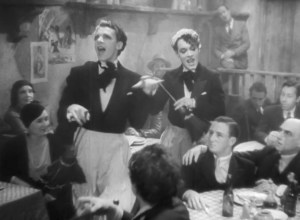
GC: And then the film shows you them walking into a basement speakeasy cabaret, where there are two waiters swishing around, singing a song about how they’d like to be on a sailor’s ship and all the sailors that they could pursue.
———
Speakeasy Waiters, Call Her Savage:
… as chambermaids
And go dashing up and down the hallTru la la la la la la la
Tru la la la la la la la…
———
EM Narration: The two waiters aren’t in full drag exactly, but in that fairy way George described, they’re somewhere in between. They’re wearing French maid outfits, flouncing about, and wielding feather dusters like they’re majorettes—no wigs, just little bonnets, and what looks like a touch of eyeliner and lipstick.
———
Speakeasy Waiters, Call Her Savage:
If a sailor in pajamas I should see
I know he’d scare the life out of me
And on a great big battleship you’d like to be
Working as chambermaids
———
GC: And I tell you, what they’re showing you is what you could find in certain Greenwich Village cafés and certain Harlem cafés in the ’20s and early ’30s. Just an incredible openness. They were very visible.
———
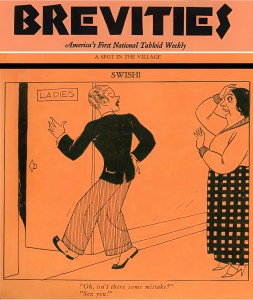
EM Narration: That visibility is also apparent in this song. In it, an onlooker is comically gobsmacked by the ubiquity of these so-called “masculine women, feminine men.”
———
Irving Kaufman: [Singing “Masculine Women! Feminine Men!”:]
Masculine women, feminine men
Which is the rooster, which is the hen?
It’s hard to tell ’em apart today
And, say…
———
EM Narration: This was a time before the terms “straight” and “gay” were in mainstream use to mean sexual opposites. The fairies, as well as “normal” men, were part of a far more fluid male sexual culture.
———
GC: Many working-class men went to taverns—not queer taverns, just regular taverns—where sometimes there’d be fairies bantering with the so-called normal men there, propositioning them or getting propositioned by the so-called normal men there, with no one thinking the “normal” men were queer because of it.
———
Irving Kaufman: [Singing “Masculine Women! Feminine Men!”:]
You go in to give your girl a kiss in the hall
But instead you find you’re kissing her brother Paul…
———
EM Narration: George says this sexual fluidity is exactly why prison officials separated inmates like Gene Mosely from the rest of the prison population on Welfare Island, and sent them to the Fag Ward.
———
GC: They took it for granted that those prisoners would be attracted to the fairies and would wanna have sex with them.
EM: So it was a super segregation. It wasn’t just homosexual men; it was fairies and queens.
GC: Overwhelmingly, the people in the Fairy Annex were gender nonconformists, were fairies, whatever they had been arrested for.
———
EM Narration: All of this brings us back to the real Gene Mosely, who was very likely a fairy—and a participant in this vibrant, highly visible subculture.
One of the other scraps of evidence that we have of Gene’s life is another newspaper article from a few months after the one we mentioned earlier. Incredibly, this article isn’t just a reprise for Gene, it also features the exact same cop—George Meyers—in a starring role.
Allan K. Washington, who portrays the fictional Gorgeous Nothings Gene, read it aloud for us.
———
AW: This is from Variety. Variety? They’re so obsessed with Gene. Okay!
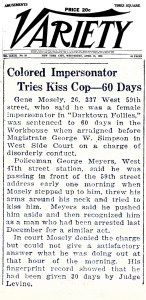
Colored Impersonator Tries Kiss Cop—60 Days
Gene Mosely, 26, 337 West 59th Street, who said he was a female impersonator in Darktown Follies, was sentenced to 60 days in the workhouse when arraigned … on a charge of disorderly conduct.
Policeman George Meyers … said he was passing in front of the 59th Street address early one morning when Mosely stepped up to him, threw his arms around his neck, and tried to kiss him. Meyers said he pushed him aside and then recognized him as a man who had been arrested that December for a similar act. … Mosely denied the charge but could not give a satisfactory answer what he was doing out at that hour of the morning.
Wow. I get the sense that there’s a lot missing from what really happened from this little blurb.
———
EM Narration: This article gives us a few more breadcrumbs to follow. It tells us where Gene lived. The listed address, 337 West 59th Street, is just a block west of Central Park and a mile north of Times Square, and back then it was a largely Black, working-class neighborhood. It also mentions Gene’s job as a female impersonator in Darktown Follies, so it’s plausible he was actually a performer in a follies.
But back to the big hole in this story. Poor Policeman George Meyers just happened to be passing Gene’s place one morning and Gene throws himself at him? It defies credibility that Gene would kiss a cop—the exact same cop who arrested him months earlier, unprompted, outside of his own home?
———
AW: This is making me think about the ways that I think often these policemen would lure these men into these situations because I honestly cannot imagine that Gene would just try to kiss a cop randomly for no reason.
EM: He might have had it in for Gene and made it up.
AW: Mm-hmm.
EM: You know, that wouldn’t surprise me…
AW: Exactly.
EM: … at all.
———
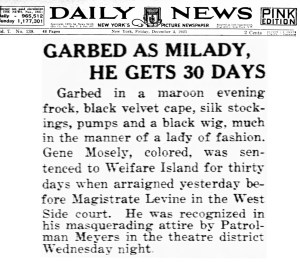
EM Narration: Or could it be that Gene and this officer had a much longer tit for tat? Going back to Gene’s first arrest from a few months earlier, there’s another, shorter blurb from a different newspaper reporting the arrest, which includes one intriguing detail. It says Gene Mosely was “recognized in his masquerading attire by Patrolman Meyers.”
Patrolman Meyers recognized Gene—huh? Sounds as though these two had some sort of history, even before that first arrest. Maybe. We’ll likely never know for sure.
All we have are these bits and pieces of Gene Moseley’s story, just the outlines of a person. But clues in the archive can help us paint a fuller picture of Gene’s world, and what might have been going on between Gene and that policeman.
———
Brian Ferree: You don’t see this very often, but his offense in 1937 was “Disorderly conduct: fairy.”
EM: And what does that mean?
BF: That means exactly what you think it means.
———
EM Narration: That’s Brian Ferree, an archivist at the New York City Municipal Archives, who was also part of the research team for The Gorgeous Nothings, searching for arrest records and other clues about the people imprisoned on the Fag Ward.
Brian and I are in the Municipal Archives’ reading room, a sterile white space filled with documents laid out on tables for us to view, and he’s showing me one particular arrest record.

———
BF: You had asked about Gene Mosely, which isn’t someone that I was able to find any information on. But when you talk about borrowing details from someone else’s life, this is someone who was arrested multiple times.
———
EM Narration: As Brian says, this isn’t Gene Mosely’s arrest record, but this case sings in the same key as Gene’s. It’s the same time period, and this person was also arrested for wearing women’s clothes.
———
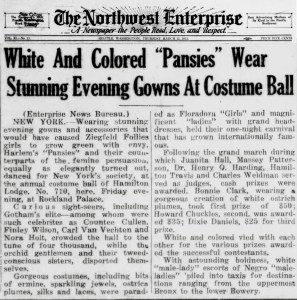
BF: In this case, I think they’re using it because he was coming from a masquerade, a masquerade ball at the Rockland Palace.
———
EM Narration: At the time, drag masquerade balls were all the rage for both fairies and straight voyeurs, and the ball held at the Rockland Palace in Harlem was the epicenter of the scene.
———
BF: These cops could have been stationed outside waiting for people to come out in drag. But I think you kind of have to read between the lines on a lot of these charges. These aren’t people that are being ripped off the stage; these are people who are living their lives on the street.
EM: I’m just gonna read a passage, if that’s okay. It says:
When interviewed, the defendant stated that he had gone with a friend of his to a masquerade ball at the Rockland Palace in New York. There he was approached by the detective, who began to make overtures to him and asked to take him home.
So the detective asked to take him home.
The defendant was in an intoxicated condition, and he agreed. Both entered a taxi cab, where the defendant was asked by the detective to commit an abnormal sexual act with him, offering to pay him $5. The defendant states that he refused to do so as well as to go to a hotel, which the detective proposed. The arrest was then made. The defendant insists that he is innocent.
And I say he was innocent. The—he was framed!
BF: They were not shy to entrap people back then.
EM: But that’s not even—that’s beyond entrapment. That’s, that’s making up a case, um, against a guy who was just living his life, you know, dressed however he was dressed. That’s appalling.
———
EM Narration: That arrest was a part of a larger sweep of history, when fairies—on stage and in the street—faded into the background, forced into the much-fabled postwar closet. As the Great Depression wore on, a surge in moralistic policing saw bars and nightclubs raided and performers ripped off the stage.
On screen, the Hays Code, meant to clean up the supposed immorality of motion pictures, was enacted in 1934, making filmed depictions of homosexuals rare and far more coded. It would take until 1962—30 years after Call Her Savage—for another gay bar to appear in movie theaters.
When the Pansy Craze ended, so too did a kind of gay life embodied by people like Gene Mosely, and now re-embodied by Allan K. Washington as Gene in The Gorgeous Nothings.
———
AW (GN Rehearsal Audio): Could be interesting, going way back to “Little Red,” when I skipped…
———
AW: I’m not sure that I can, like, articulate it, but it just makes me feel like I am doing something important by representing this person that has been sort of lost to history. And to sort of, like, present them to the world in all of their power, in all of their beauty, in all of their dignity feels really exciting.
———
EM Narration: One way Allan gets to do that is with the defiant number “Ain’t Nobody’s Business,” the show’s big I-am-what-I-am moment. Near the end of the show, in the face of pressure to change, Allan’s Gene taunts the audience, and the police, to dare them to be anyone other than themselves.
———
Gene, GN (AW): [Singing “Ain’t Nobody’s Business”:]
If I should take a notion
To jump into the ocean
Ain’t nobody’s business if I do…
———
EM: Can you imagine being in Gene’s shoes, walking down the street, as you did today? Can you put yourself in Gene’s shoes and imagine?
AW: I am trying to put myself in Gene’s shoes and imagine walking down Eighth Avenue, looking fabulous. Especially now I think people would love to see Gene walking down the street, and I think Gene would be so celebrated. And also it would be almost like nothing, you know what I mean? I feel like there would be people walking past Gene and just not even thinking twice about it.
I feel like I can draw such a clear thread from Gene to now. It’s so clear to me that, like, oh, yeah, because of the way that Gene moved through the world, I am able to be myself now, too.
EM: Watching you as you describe Gene, you may not be aware, but your shoulders go back and you sit up a little straighter.
AW: That’s what it does to me, that’s what that, that idea does to me. And I think that’s what Gene does to me as well. Like, I, I love being able to embody this character because he really makes me move differently and it, it’s powerful.
———
Gene, GN (AW): [Singing “Ain’t Nobody’s Business”:]
’T ain’t nobody’s business if I do
Travis Russ: Yes. Allan, this is gonna be fucking great.
———
Gladys Bentley: [Singing “Gladys Isn’t Gratis Anymore”:]
People think that I’m naive
But there’s something up my sleeve
———
EM Narration: Next time, we pick up one more thread of Gene’s tapestry and go uptown, to one of those drag balls, and spend some time at a basement bar with one of Harlem’s most notorious male impersonators.
———
Cookie Woolner: She became well known for singing naughty versions of popular songs, such as a take on the popular Broadway tune “Sweet Georgia Brown” and the song “My Alice Blue Gown,” turning them into an ode to the joys of anal sex.
EM: Whoa. And that was in the 1930s?
———
Gladys Bentley: [Singing “Gladys Isn’t Gratis Anymore”:]
There’ll be no Annie Oakley as before
You’re gonna pay before you enter through her door
Unidentified Male Vocalist:
The back door or the front door, girl?
———
EM Narration: This Making Gay History episode was written, produced, mixed, and sound designed by Benjamin Frisch and executive produced by our founding editor, Sara Burningham. With production help from Will Coley, Bart Warshaw, Max Miller, and Tarcisio Longobardi. Our studio engineers were Michael Bognar, Cathleen Conte, Katherine Cook, and Charles De Montbello at CDM Sound Studios. Making Gay History’s theme music was composed by Fritz Myers.
Thanks to our listening circle, including Dane Stewart, Jenna Weiss-Berman, and Jeffrey Masters. Thank you to our photo editor, Michael Green, and fact-checker, Matt Koff. With editorial support from Making Gay History’s deputy director, Inge De Taeye. Thank you, also, to the New York Public Library Manuscripts and Archives division for their ongoing assistance. Special thanks to historian George Chauncey and archivist Brian Ferree for their assistance.
To learn more about the people and stories featured in our episodes, please visit makinggayhistory.org, where you’ll find links to additional information, archival photos, as well as full transcripts.
“The Queens Of Welfare Island” is a production of Making Gay History. It was made possible with generous support from the Life Jacket Theatre Company, the Jonathan Logan Family Foundation, Ty Ashford and Nicholas Jitkoff, Broadway Cares/Equity Fights AIDS, Christopher Street Financial, the Marcus Family Foundation, Rick Hoffman, Bill Kux, Robert Dodd, Maureen Bennett, Maria Lefkarites, Emily and David Tobin, Richard and Mynette Marcus, the Calamus Foundation, and Christine, Bryan, and Alex White, in addition to the many hundreds of other donors who make it possible to bring you this work.
I’m Eric Marcus. Until next time.
———
Durium Dance Band: You have just heard, “Let’s All Be Fairies.”
###