The Queens of Welfare Island — Episode Four: The Sodomite
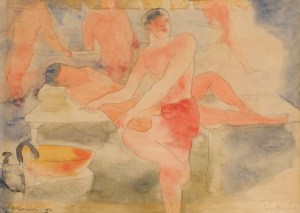
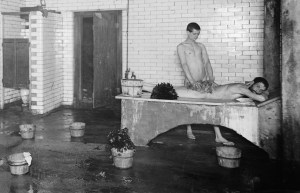
 Bathhouse massage rooms depicted in "James Everard’s Turkish, Roman and Electric Baths" (James Everard, 1892). Credit: Courtesy of Avery Classics, Avery Architectural & Fine Arts Library, Columbia University.
Episode Notes
In 1903, New York City police conducted the first documented raid of a gay bathhouse in the U.S. Among the 26 arrested was Abraham Krigel, a Jewish immigrant, tailor, father, and husband, who found himself at the center of a legal firestorm that threatened to put him behind bars for years.
Episode first published November 23, 2026.
———
Note: In newspaper articles, court documents, and official records, Abraham Krigel’s last name is variously spelled as “Kriegel,” “Kregal,” “Kriegal,” and “Krigel.” For consistency’s sake, this webpage uses “Krigel” throughout.
———
Learn more about some of the topics and people discussed in the episode by exploring the links below.
The character of Abraham in The Gorgeous Nothings:
- General information about the musical on the Life Jacket Theatre Company website.
- A 2026 New York Times profile of John Cariani, the actor who plays Abraham and who is also a noted playwright.
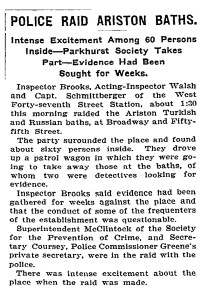
The February 21, 1903, raid on the Ariston Baths and the legal fallout:
- A snappy video overview by Amanda W. Timpson (Yesterqueers/Instagram).
- “The Social World of Baths,” chapter 8 of George Chauncey’s Gay New York: Gender, Urban Culture, and the Making of the Gay Male World, 1890-1940 (Basic Books, 1994).
- “Sodomy, Manhood, and Consent,” chapter 5 of Respectability on Trial: Sex Crimes in New York City, 1900-1918 by Brian Donovan (SUNY Press, 2016).
- Transcript of Abraham Krigel’s April 1903 trial; trial transcripts of Krigel’s fellow Ariston arrestees George Galbert, Theodore Casson, Walter Bennett, and Michael Schnittel (Lloyd Sealy Library Digital Collections, John Jay College of Criminal Justice/CUNY).
- Contemporary New York Times coverage of the raid; the arraignment of 14 of the arrestees, including Krigel; Krigel’s failure to appear for his third trial; and the 20-year sentence Krigel’s fellow arrestee John Rogers received.
General resources about the history of bathhouses:
- “Manhattan’s Last Remaining Bath Houses” by Dena Tasse-Winter, a brief history of New York City’s public bathhouses (Off the Grid, Village Preservation blog, Aug. 2024).
- “The History of Gay Bathhouses,” a seminal article by Allan Bérubé (Journal of Homosexuality, Vol. 44, No. 3-4, Feb. 2003; originally published in 1984).
- “Genealogy of the Gay Bathhouse,” an essay by Mathias Foit that traces the lineage of the modern gay bathhouse to the Roman thermæ and the Ottoman hammam (Gay & Lesbian Review, Sept.-Oct. 2026).
Sodomy laws:
- Brief history of the criminalization of homosexuality in the United States, from the colonial era to the 2003 U.S. Supreme Court decision Lawrence v. Texas, which struck down state sodomy laws (Death Penalty Information Center).
- Dishonorable Passions: Sodomy Laws in America, 1861-2003 by William Eskridge, a comprehensive history (Viking, 2008).
- Flagrant Conduct: The Story of Lawrence v. Texas by Dale Carpenter (W.W. Norton, 2012).
- Timeline of sodomy laws in New York State, compiled by George Painter; the website provides similar timelines for other U.S. states and other countries.
———
Episode Transcript
A heads-up for listeners: This episode contains explicit descriptions of gay sex, from 1903.
———
Eric Marcus Narration: This is the night that sent a Jewish immigrant, with five kids and a wife at home, to Welfare Island’s Fag Ward, as dramatized in The Gorgeous Nothings.
The man’s name is Abraham, and he’s a tailor. A stranger comes through the door.
———
Abraham, The Gorgeous Nothings (John Cariani): It was getting late, and I was closing up my little shop.
Customer, GN (Arnie Burton): Wait, wait! Excuse me, tailor, I have a hole in my jacket. I know it’s late, but my jacket needs mending.
Abraham, GN (JC): I have never seen this strange man before.
———
EM Narration: The man roots through his pockets looking for money, to no avail. He offers something else in exchange.
———
Customer, GN (AB): I can give you… this.
Abraham, GN (JC): With that he give me ticket, small ticket. It say—
Customer, GN (AB): Turkish bathhouse…
Abraham, GN (JC): 405 Lafayette Street…
Customer, GN Customer, GN (AB): Greenwich Village.
Abraham, GN (JC): And with that he was gone. Disappear—poof—like magic.
———
EM Narration: Abraham closes the shop and takes the subway in the direction of home. But he gets off two stops early.
———
Abraham, GN (JC): And I look up and I am standing at 405 Lafayette Street. Well, don’t go in, I say to myself. But then I see myself giving ticket to this man, and he give me towel and key to lockbox. I go in. The air, it smell like sweat and honey and leather.
Policeman, GN (J. Harrison Ghee): 11:30 p.m. Abraham enters the cooling room where he performs oral sex.
———
EM Narration: The voice of a police officer, secretly observing from the wings.
———
Abraham, GN (JC): And I can hear this music playing. It’s maybe phonograph, I think. And I, I, I, I follow the sound.
Policeman, GN (JHG): 1:02 a.m. Abraham enters the changing room, where he performs anal sex with two other men at the same time.
Abraham, GN (JC): And I tell myself to go, to leave, to run.
Policeman, GN (JHG): 1:39 a.m. 13 policemen raid the bathhouse
Abraham, GN (JC): But I, I, I don’t go, I don’t run. I just stand there, with them, frozen.
Policeman, GN (JHG): The officers arrest 78 homosexuals that night, including Abraham.
———
EM Narration: Suddenly, Abraham is in court, facing his arresting officer.
———
Policeman, GN (Noah Wolfe): And that, that is the man I saw.
Abraham, GN (JC): And, and I want to put my clothes back on and get back on train as normal, and travel two more stop as normal, and walk through my door as normal, and, and kiss my wife as normal, and hug my children as normal, and go to sleep as normal.
Judge, GN (J. Harrison Ghee): This court sentences the defendant to the maximum of 20 years.
———
EM Narration: I’m Eric Marcus and this is Making Gay History: The Queens of Welfare Island.
The scene you just heard was inspired by true events. The fictionalized raid in Greenwich Village that sweeps up the tailor Abraham in the Gorgeous Nothings musical is actually based on an early 20th-century police raid on the Ariston Baths, a couple of blocks south of Central Park. The sting resulted in 26 arrests, 12 trials, and seemingly endless scandals. It was the first documented raid of a bathhouse in the United States.
Among those arrested in the real raid in 1903 was a man named Abraham Krigel, a Jewish immigrant, tailor, father, and husband, who found himself at the center of a legal firestorm that threatened to put him away for years, even decades.
More than a century later, that Abraham and that raid inspired this Abraham and this raid in the Gorgeous Nothings musical. The true events that inspired this scene are no less dramatic, shocking, or scandalous than the musical theater version. Arguably more so.
Today, we present to you a turn-of-the-century true crime chronicle. We’re going to find out what happened on that fateful night. We’ll meet a mysterious stranger, visit a steam room full of towel-clad undercover cops and mostly naked men, witness Kafkaesque trials and tribulations, and share some blush-worthy descriptions of men engaged in every manner of sexual behavior.
This is episode four: “The Sodomite.”
———
John Cariani (Abraham, GN): Abraham is married, has five children, and then got this ticket to go to a bathhouse. Went in, and lost his mind.
———
EM Narration: The actor John Cariani plays Abraham in The Gorgeous Nothings.
———
JC: I think Abraham, he was so curious about what this bathhouse was, and whatever happens with the man who gives him the ticket to invite him to go to the bathhouse, I think there’s some electricity there that he wants to see what that is.
———
EM Narration: In this, both Abrahams, real and fictional, are alike. But in other ways they differ, including the when of it all. While the Gorgeous Nothings musical is staged in Welfare Island’s Fag Ward in the early 1930s, the true events the fictional Abraham is drawn from happened three decades earlier, in 1903.
The real Abraham Krigel was born in 1865 in what is now western Ukraine. In 1890, he and his wife Dora emigrated to the U.S. and settled in New York City. They lived on the Lower East Side, where hundreds of thousands of mostly Eastern European Jews lived in overcrowded tenements.
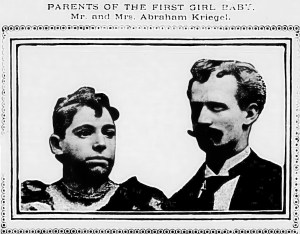
By 1900, Abraham and Dora had four children, but part of what we know about Abraham’s home life comes from the unusual circumstances of their fifth child’s birth. Here’s a snippet of an article from the January 5, 1901, edition of the Evening World, read by John Cariani.
———
JC: [Reading the Evening World Excerpt:]
The stork is considerably faster than Manhattan Rapid Transit. … it was two minutes past 12 o’clock when a bouncing little girl weighing close to nine pounds … was left with the happy parents.
It was the first girl to be born in the new century.
———
EM Narration: Abraham’s first 15 minutes of fame came with a gold medal and a brass crib. The article features a photo of baby Katie Krigel, the first 20th-century girl, according to the paper. She’s wide-eyed in a puffy-sleeved infant gown beneath a formal portrait of Abraham and Dora. Abraham looks especially dashing with a suit and tie, slicked-back hair, and mustache.
Article in the Evening World edition of January 5, 1901, reporting on the first babies born in Greater New York in the 20th century. Credit: Library of Congress.
———
JC: [Reading the Evening World Excerpt:]
Their father has a little tailoring business at 155 Suffolk Street … derives enough profit to keep his family supplied with the good things of this world.
A pretty home, beautifully furnished, will be the home of little Katie. … Mamma Krigel was just as happy that her baby was the first of the girls of the 20th century. …
“I don’t know what to say. I am so happy,” she said. “I thank the Evening World for the kindness, and I know just as soon as little Katie is old enough to do so, she will show her appreciation.”
———
EM Narration: This article paints the Krigels as a model American family, while papering over the realities they experienced as newcomers. For one thing, Dora couldn’t speak or write in English, so those words, if they were her words, must have come through a translator.
The apartment mentioned in that article was the top floor of a five-story walk-up double tenement, a building they shared with 20 other families. And though their apartment may have been, as the Evening World put it, “a pretty home” and “beautifully furnished,” those furnishings almost certainly did not include a private bathroom.
———
George Chauncey: There already had been a tradition of public baths because very few people in those tenement districts had plumbing or certainly bathing facilities.
———
EM Narration: George Chauncey, author of Gay New York.
———
GC: There was definitely a gay bathhouse culture going way back to the beginning of the 20th century.
———
EM Narration: Tenements like the one that housed the Krigels were such a public health problem that in 1895, New York State passed a law that made public baths a mandatory public service, and they were commonplace in the city’s most crowded neighborhoods. But these baths kept a close eye on their patrons, discouraging sexual activity. Soon enough, private bathhouses specifically catering to gay men began to appear.
———
GC: As early as 1902, 1903, we have records of at least one bathhouse in New York City which clearly had dedicated itself to serving men interested in sex with other men.
———
EM Narration: The fictionalized version of events in The Gorgeous Nothings describes a Greenwich Village bathhouse. But the real Abraham Krigel was arrested at a bathhouse just south of Central Park.
———
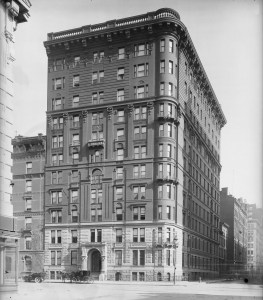
GC: The Ariston Baths on Broadway at 55th Street catered to men interested in sex with other men. And everyone understood what was going on, and everyone was there for the same reason.
———
EM Narration: Which brings us to the evening of February 21, 1903—the night that would change the Krigels’ lives forever.
At around 8 p.m., Abraham Krigel was at his tailor shop when a mysterious visitor appeared. Krigel later testified—
———
Abraham Krigel Voice-Over:
A man came around, a German man. He said, “Tailor, will you do me a job right away?” I said, “Yes, I will, what is it?” He said, “To repair, to fix up, and sew a few buttons on, and to press it as quick as you can.”
———
EM Narration: Krigel did the work and charged the man 75 cents—about $30 in today’s money. The man gave him a dollar in return and told him to keep the change. And then, on top of that, the man offered Krigel something else: a ticket to a Turkish bathhouse, the Ariston Baths. The man said he had a train to catch and he couldn’t use it anyway.
———
AK VO:
I refused it. … I had no use to go in the night time.
———
EM Narration: But we know that in the end, Krigel went to the Ariston Baths that night—a bathhouse he claimed to have no knowledge of, and never before visited.
So, in Krigel’s telling, a client asked for a rush job, overpaid, then offered up a ticket to a gay bathhouse to a man he didn’t know as a bonus? Sounds like fiction.
But, remarkably, Krigel’s stepfather-in-law was there at the shop when all this went down. In court, he testified that this unusual exchange did indeed occur. In any case, there’s no disputing that later that evening, Krigel found his way to the basement of a building on West 55th Street and Broadway.
———
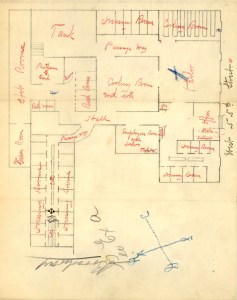
EM: Is that a map of the bathhouse?
Brian Ferree: This is actually in Abraham’s file, which is amazing. But, yes, this is a floor plan of the bathhouse.
EM: Wow.
———
EM Narration: I’m in the reading room of the New York City Municipal Archives. Brian Ferree, an archivist here, who was also part of the research team for The Gorgeous Nothings, has pulled some of Krigel’s files for us.
Included is this floor plan, neatly hand drawn in pencil on yellowing paper. The names of individual rooms are labeled in red cursive.
———
EM: And I see there’s the hot room, the steam room, the tank, dressing room, cooling room, parlor, and then it has little dressing rooms. I guess these were not quite dressing rooms; these look like assignation rooms.
BF: That is very possible.
EM: Yes.
———
EM Narration: Abraham Krigel entered the baths at approximately 11:30 p.m. He descended a flight of stairs, into a vision of Sodom itself: a heated labyrinth of seemingly endless rooms and steam-filled passages packed with men clad in nothing more than Turkish bathing sheets, if that, dimly lit and cast in shadow.
As Krigel made his way through the maze, several pairs of eyes were on him. He found his way to the cooling room, a tucked-away space filled with cots in the southeast corner of the complex. There, three officers were in place, observing his every move.
———
BF: They were in towels in there with them.
EM: So the police were watching this?
BF: Oh, yeah.
EM: Yeah.
BF: They had been observing for weeks, and now they were making their big move…
EM: Oh.
BF: … standing feet away from them.
EM: Oh. Oh.
———
EM Narration: The cops needed to be there to get what they were after. They weren’t looking to send these men away with a misdemeanor charge and a couple months on, say, Welfare Island. They wanted bigger fish: sodomy charges, which carried years-long sentences and required eyewitness testimony.
In Abraham’s case, here is what the police claimed to see, in explicit detail, from the original criminal complaint from 1903.
———
EM: [Reading from criminal complaint:]
The said Abraham Krigel did voluntarily submit to be carnally known by one Charles Chamberlain, by and through the anus of the said Abraham Krigel. And did carnally know one John Rogers, by and through the mouth of the said John Rogers, and did voluntarily submit to such carnal knowledge on the part of said John Rogers in manner as follows.
Okay, here we go.
BF: Get ready.
EM:
The said Chamberlain, naked with a sheet thrown loosely over him, was standing in a room, his penis being then and there in a state of erection. The said Krigel, also naked with a sheet loosely thrown over his shoulders, then and there stood in front of the said Chamberlain with his back towards him, and thereupon the said Chamberlain…
Oh my goodness.
… inserted his penis into and through the anus of the said Krigel and kept it there, during all of which time the said Chamberlain and the said Krigel were making indecent motions.
Oh, my god.
And towards the end of the said time, the said Chamberlain went through the motion of ejaculation, after which the said Chamberlain’s penis was withdrawn from the anus of the said Krigel, and upon being so withdrawn, it was not any longer in a state of erection.
BF: Eric, are you turning red?
EM: Yes, I am. And I don’t mean to make light of this, I just—I, I, I, I’m actually shocked by the, the detail.
Criminal complaint against Abraham Krigel sworn to by Norman Fitzsimmons, one of the undercover policemen who participated in the February 21, 1903, Ariston Bath raid. Credit: New York County District Attorney record of cases, New York City Municipal Archives.
———
EM Narration: There’s more, but for the sake of brevity, and my own blushing cheeks, I think you get the picture.
Soon after the police say they witnessed these acts, the raid was on. A squad of police rushed in, blocked the exits, and corralled the patrons, taunting them as fairies. The police yelled, “Come out here, Maude” and “Oh, here is the indignant lady,” as they sorted the 78 patrons from Ariston staff. The men were allowed to dress before being paraded in front of the investigating officers, who picked out the ones they could identify.
Twenty-six men were thrown in police vans and locked up for the night. Sixteen of those men were held on sodomy charges, and 12 of them made it to trial, including Abraham Krigel.
———
EM:
… wherefore deponent charges the said Abraham Krigel with the crime of sodomy and asks that he be held and dealt with as the law directs.
———
EM Narration: Abraham Krigel had a lot to lose. He was the sole breadwinner of his family, with a wife and five children to support. A sodomy charge carried a maximum penalty of 20 years in prison. He pleaded not guilty before the magistrate.
Almost immediately, the story of the raid blew up in the press. The New York Times ran an article detailing Krigel’s arrest, and mentioning two of his alleged accomplices, under the headline “Ariston Prisoners in Court.”

———
Excerpt from “Ariston Prisoners in Court,” New York Times:
Abraham Krigel, a tailor … examined and held in $2,000 bail … Charles Chamberlain, who refuses his address and says he is a designer, pleaded not guilty … John Rogers, who had nine charges against him, waived examination and was held in $3,500 for trial.
———
EM Narration: The English language press mostly left the nature of the alleged crimes to the imagination, but the Yiddish press was less sparing. They ran a story with a headline that translates to “Turkish Bath — Turkish Harem.”
———
Excerpt from “Turkish Bath — Turkish Harem,” Forverts:
Several dozen respectable family men were packed into patrol wagons—not for wearing non-kosher tzitzit or eating without a cap.
… The reason for the raid was that police had learned that in the “Russian-Turkish Bath” crimes against morality were being committed.

———
EM Narration: The social and financial consequences for Abraham, Dora, their children, and their place in a tight knit community were immense.
While Krigel’s bail was first set to $2,000, it was subsequently raised to a staggering $4,000—over $150,000 in today’s money. He couldn’t pay it. So he spent his pre-trial days among the rats in the Tombs, New York City’s notorious holding cells for the accused awaiting trial.
He first appeared before a jury on March 15, less than a month after his arrest. We don’t have the transcripts of this trial, but we do know it lasted four days and that it ended with a hung jury. Five jurors voted to convict Krigel, seven to acquit him. If the D.A. wanted a conviction, he’d need to try again,
As was typical between mistrials, Krigel’s bail was reduced to $1,500, which he was able to afford with the help of a bondsman, freeing him from jail, at least temporarily.
The following month, on April 7, Krigel was subjected to a second trial. Unlike his first, this one survives in the form of court transcripts, thankfully preserved on blurry, but mostly legible microfiche.
On the day of his retrial, Abraham Krigel stood before a jury of his peers. Beside him was his defense attorney, Leonard Snitkin; opposite him was Assistant District Attorney James Ely. All stood before Judge John W. Goff as he opened the trial. The prosecution presented a straightforward, confident case. During opening statements, Ely declared—
———
A.D.A. James Ely VO:
It is alleged that this defendant, who was then undressed and naked with the exception of the ordinary Turkish bath sheet, went into the room there at the southeasterly side of the Russian bath establishment, and there voluntarily submitted to carnal knowledge with one Charles Chamberlain through the anus … One John Rogers had carnal knowledge with this defendant, the defendant voluntarily submitting, through the mouth of said John Rogers … When we prove these facts, gentlemen of the jury, we shall ask you for a verdict of guilty of sodomy as charged in the indictment.
———
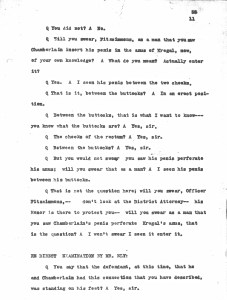
EM Narration: Ely called one of the policemen who participated in the sting as his first witness. His testimony mirrored the original complaint, and he recited once more what he observed that night in the cooling room.
———
Officer Hibbard VO:
Chamberlain’s penis was in a state of erection. I saw the defendant stand between Chamberlain and the end of the cot, and I saw the man Chamberlain pull Krigel towards him, and he moved towards Krigel … and go through indecent motions.
The man Rogers … sat on the end of the cot and placed his mouth over the penis of this defendant, and this defendant went through the motions of ejaculation…
———
EM Narration: This was the essence of the prosecution’s case: These sex acts between these three men were witnessed and corroborated by multiple officers. It was presented as an open-and-shut case.
But Krigel’s defense attorney, Leonard Snitkin, cast some doubt on the police testimony. Snitkin was himself a Jewish immigrant. He’d come from Russia as a boy and was educated in New York City public schools. When he represented Krigel he was only in his mid-20s. Even on the blurry pages of the transcript, his words stand out.
During his cross-examination, he questioned the officer’s ability to accurately describe what they’d seen. He has this exchange with Hibbard, the undercover officer, about the lighting in the cooling room.
———
Defense Attorney Leonard Snitkin VO:
Was there a chandelier in that room?
Hibbard VO:
There was.
Snitkin VO:
Was that chandelier lit up?
Hibbard VO:
It was not lit.
Snitkin VO:
So there was no light in that room…?
Hibbard VO:
There was no jet of gas or electric light, but the light shone in from the other room.
———
EM Narration: Snitkin was saying that the police officers could hardly see. That hand-drawn map of the bathhouse corroborates this reading. Based on where the officers say they were located, and the placement of the door in that tucked-away cooling room, the space would have been cloaked in shadow.
After the police officers, the prosecution brought out another blockbuster witness: Arthur Chamberlain Dodds. Dodds was, in truth, the real identity of Charles Chamberlain, the man accused of penetrating Krigel on the night in question. He’d given the police a mostly fake name. He testified—
———
Arthur Chamberlain Dodds VO:
I went into that room and was standing … there with my back to the wall and Krigel came in and stood in front of me … and I put my penis into his anus, and after that I went out.
———
EM Narration: Again, pretty open and shut. But on cross-examination, Snitkin again created room for doubt.
———
Snitkin VO:
You are awaiting your sentence?
Dodds VO:
Yes, sir.
———
EM Narration: Dodds, aka Chamberlain, had already pleaded guilty. Snitkin then implied, with many objections from the D.A., that Dodds’s testimony might all be part of some kind of a deal to reduce his own sentence. Dodds also previously claimed, under oath, that he’d never seen Krigel before in his life. Snitkin’s argument was clear: How can we trust this guy when he’s already admitted to lying under oath?
It was now the defense’s turn to bring witnesses. First up, Abraham Krigel took the stand in his own defense. He began his testimony, speaking so softly that he had to be reminded to speak up so the jury could hear him.
Krigel recounted the story of acquiring the ticket to the bathhouse from the mysterious stranger, and going to the baths for the first time, not knowing its reputation. He also denied any and all sexual contact with Rogers and Chamberlain, but he did admit to seeing and interacting with Chamberlain at the baths. He recalled an encounter with the man while in the changing room.
A January 22, 1905, New York Herald article about the Everard’s Baths. According to the NYC LGBTQ Historic Sites Project, it was “one of the most legendary and long lasting of New York’s bathhouses … a refuge for gay men probably since its opening in 1888, but definitely by World War I.” The bathhouse was subject to major police raids in 1919 and 1920. The city closed it down in 1986 as part of an effort to curb the HIV/AIDS crisis.
———
Krigel VO:
He said to me, “Be kind and give me a cigarette and I will treat you to a little whiskey” … and he treated me with this bottle of whiskey.
———
EM Narration: Later, he says he developed a headache and looked for a place to lay down. He then encountered Chamberlain again, this time in the cooling room.
———
Krigel VO:
Chamberlain put his hand on my shoulder, one hand, and with the other hand he punched me in the side.
———
EM Narration: This punch ultimately goes unexplained, even on cross-examination, but Krigel claimed it was enough for him to end his night at the Ariston Baths.
———
Krigel VO:
I said, “To hell with this place, I better go home and dress myself, I will be better off.”
———
EM Narration: Of course, Krigel didn’t go home. He was arrested.
The prosecutor called multiple witnesses who disputed Krigel’s testimony, especially his claim that he was unfamiliar with the baths. Two police officers testified they had seen Krigel at the Ariston Baths earlier that month.
Defense attorney Snitkin summoned a parade of character witnesses to testify to Krigel’s upstanding reputation, including fellow tailors and family members, even his wife Dora, who took the stand but was quickly withdrawn when the court realized she only spoke Yiddish.
But the real crux of Krigel’s defense wasn’t character; it was anatomy. The star witness was Pierre Siegelstein, a physician, surgeon, and expert witness who had testified in multiple sodomy cases. Defense attorney Snitkin said—
———
Snitkin VO:
I ask you from the relation of the anus, from the position and direction of the penis when it is erect, could such an act be perpetrated in a standing position?
Dr. Pierre Siegelstein VO:
Absolutely a physical impossibility. … The anus is always obstructed by the heavy folds of the buttocks, which must be well separated before you can gain introduction into the anus, to stretch the contracting muscles. … All of these facts convince me that it be more possible for the elephant to pass through the ear of a needle.
———
EM Narration: Yes, he does indeed say “ear of a needle.”
This claim, that anal sex was physically impossible in the position the police said they observed Krigel, was central to the defense. Of all the Ariston Baths prosecutions that survive in the records, it was only Snitkin, defending Krigel, who put forth such a remarkable argument.
The prosecution produced their own expert medical witness, one William Travers Gibb, a Welfare Island prison doctor. The D.A. asked Gibb to confirm or deny that it was possible for two men to have sex while standing.
———
Dr. William T. Gibb VO:
Yes, sir. … the act of intercouse in that posture is perfectly feasible.
———
EM Narration: At one point a diagram of male anatomy is entered into evidence, and a lengthy discussion on the intricacies of anal sex commences.
———
Snitkin VO:
… is not the anus towards the pubis?
Gibb VO:
… No, sir—the anus is not towards the pubis any more than anything else.
Snitkin VO:
… The penis when erected is upward?
Gibb VO:
Upward and forward.
Snitkin VO:
And the anus is downward?
Gibb VO:
Downward and backward.
Snitkin VO:
… Tell this jury—they are laymen—can you really see the anus of a person without separating the buttocks?
———
EM Narration: The judge shuts down this line of questioning before Gibb can answer, but the questions keep coming, from both sides.
———
A.D.A. Ely VO:
In your experience, have you ever known of cases in which the anus was in a constant state of dilation—in other words, not closed at all?
Gibb VO:
Yes, sir.
Ely VO:
In what class of cases?
Gibb VO:
Sodomite.
———
EM Narration: After three days, the trial was over, and Krigel’s fate was in the hands of the jury. For a second time, the jurors disagreed: Two voted to convict, the rest were not so sure.
It seems that Snitkin’s arguments about impossible sex were enough for 10 jurors to express reasonable doubt that Abraham Krigel had engaged in sodomy that night. A second hung jury resulted in a second mistrial, and that meant Krigel and, by association, his family faced another round of humiliation in court. A judge was assigned, and a new jury was impaneled later in the month.
But when the time came. Krigel didn’t show up to trial. The court was furious, issuing a forfeiture of his bond and a bench warrant for his arrest. Later that day, police tracked down Krigel at Beth Israel hospital, where he’d been admitted as a patient, and arrested him on the spot.
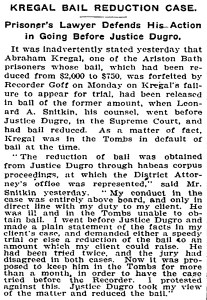
It was a whole new scandal. The New York Times covered it, as did a Yiddish language newspaper, which ran a story that translates to, “From the Hospital to Prison”:
Yesterday, Abraham Krigel was taken from Beth Israel hospital and transported to the Tombs, where he will have to remain until a certain trial he is facing comes to an end.
Was he actually sick? Was it a mental breakdown? It’s impossible to say. No specific cause of illness is given for his hospitalization in the court records, but in subsequent affidavits by Snitkin, he assures the court that it was all an innocent misunderstanding. Further, he explains that the incident had ruined Krigel.
———
Snitkin VO:
After the defendant’s last incarceration in the Tombs, the family of the defendant was practically dispossessed from their home … and are residing in an unhabitable and untenantable quarters.
———
EM Narration: Snitkin pleaded with the court to close the case, or get on with it. He asked—
———
Snitkin VO:
… that the indictment against him be either dismissed, or that he be allowed to go on his own recognizance. The defendant is unable to give the bail demanded, and asks that without any further delay, he be placed upon trial.
———
EM Narration: And then, the criminal case fades out. Court dockets corroborate that after the forfeiture of his bail and imprisonment, outside of some procedural hearings, there’s no verdict. No judgment, no plea deal. The state simply seems to have lost interest in Krigel’s case. After two mistrials, perhaps it had become more trouble than it was worth.
In the end, Abraham Krigel walked free—but at an enormous cost. He’d been financially ruined and personally humiliated.
Even so, he was a lucky one. John Rogers, one of the other men arrested at the baths that night, wasn’t so lucky. He got the harshest sentence of all the men caught up in the Ariston raid: a 20-year stretch at a state penitentiary. Twenty years, for visiting a gay bathhouse.
Rogers wasn’t the only one with jail time. In total, six men received years-long sentences. As for Abraham Krigel, within a few years he fled New York. A Canadian census places him in Montreal, Quebec, in 1905. Apparently, the rest of his family settled in Montreal by 1908. It was a logical enough move; Montreal was home to another one of North America’s most vibrant Jewish communities, and this one was far less likely to have ever heard of the Ariston Baths.
Abraham Krigel died in 1932. His wife, Dora, followed 10 years later. They’re buried on opposite sides of the same Jewish cemetery on Mount Royal, Montreal. We don’t know why.
Looking back at 1903 and the Ariston Bathhouse raid, it all seems so horrifically absurd. The burdens these men were forced to carry—the humiliations, the estrangements, the incarcerations—all for what? It’s pretty bleak.
But in that bleakness of the Ariston trials, there are flickers of a more tolerant future. One of those flickers came from an attorney in one of the other Ariston cases. Defense attorney Hugh Pentecost addressed the court after his client was found guilty, but before sentencing. He said—
———
Hugh Pentecost VO:
The crime for which these men have been convicted has been declared to be a crime by the Legislature … I am frank to say that I do not agree.
… While an act of this nature, it seems to me, on the contrary, is not a crime that affects the public welfare, but is, rather, to be classified as a vice; and I have a serious question in my own mind whether it ought to be made a crime at all.
… and it seems to me that the punishment does not fit the crime; and the sending of men to state prison for a very long term, because they are guilty of a personal vice, does not commend itself to my judgment.
I leave him in the hands of the Court, as I can do nothing else, except to submit to whatever sentence the Court chooses to impose upon him.
———
EM Narration: The judge gave Pentecost’s client seven years and two months. Sodomy laws that criminalized homosexuality would persist for another century after the Ariston raid. The U.S. Supreme Court finally declared state sodomy laws unconstitutional in Lawrence v. Texas on June 26, 2003.
Next time on “The Queens of Welfare Island,” gay love and nosy neighbors behind closed doors.
———
Travis Russ: Edward and Richard were arrested after a neighbor spied on them.
Brian Ferree: You’d think no one likes a rat in New York, but…
BF & EM: … there’s a lot of rats.
EM: Two-legged rats.
———
EM Narration: This episode was written, produced, mixed, and sound designed by Benjamin Frisch and executive produced by our founding editor, Sara Burningham. With production help from Will Coley, Max Miller, Bart Warshaw, Tarcisio Longobardi, and Justin Willingham. Our studio engineers were Michael Bognar, Cathleen Conte, Katherine Cook, and Charles de Montbello at CDM Sound Studios. Making Gay History’s theme music was composed by Fritz Myers.
Thanks to the team at Lambda Legal, especially Amanda Wyatt, for helping to coordinate our lawyers-turned-amateur voice actors in this episode, including Doug Curtis, Kell Olson, Nathan Douglas, Paton Moody, and Paul Castillo. Also thanks to John Cariani, Ellis Rosen, and Brian Dereck for their vocal contributions.
Thanks to our listening circle, including Josh Gwynn, Jeffrey Masters, June Thomas, Joe Richburg, Mark Joseph Stern, and Kasia Mychajlowycz.
A groysn dank to Adam Gelman, for his research and translation of Abraham Krigel’s Yiddish newspaper appearances.
Thank you to our photo editor, Michael Green, and fact-checker Matt Koff. With editorial support from Making Gay History’s deputy director, Inge De Taeye. Thank you, also, to the New York Public Library Manuscripts and Archives Division for their ongoing assistance.
Special thanks to George Chauncey and Brian Ferree for their expertise, and Daniel Schlosberg and Alejandro Senior for their musical contributions to this episode.
To learn more about the people and stories featured in our episodes, please visit makinggayhistory.org, where you’ll find links to additional information and archival photos, as well as full transcripts.
“The Queens of Welfare Island” is a production of Making Gay History. It was made possible with generous support from the Lifejacket Theatre Company, the Jonathan Logan Family Foundation, Ty Ashford and Nicholas Jitkoff, Broadway Cares/Equity Fights AIDS, Christopher Street Financial, the Marcus Family Foundation, Rick Hoffman, Bill Kux, Robert Dodd, Maureen Bennett, Maria Lefkarites, Emily and David Tobin, Richard and Mynette Marcus, Greg and Barbara Adgate, Mary Cadagin and Lee Wilson, the Calamus Foundation, and Christine, Bryan, and Alex White, in addition to the many hundreds of other donors who make it possible to bring you this work.
I’m Eric Marcus. Until next time.
###